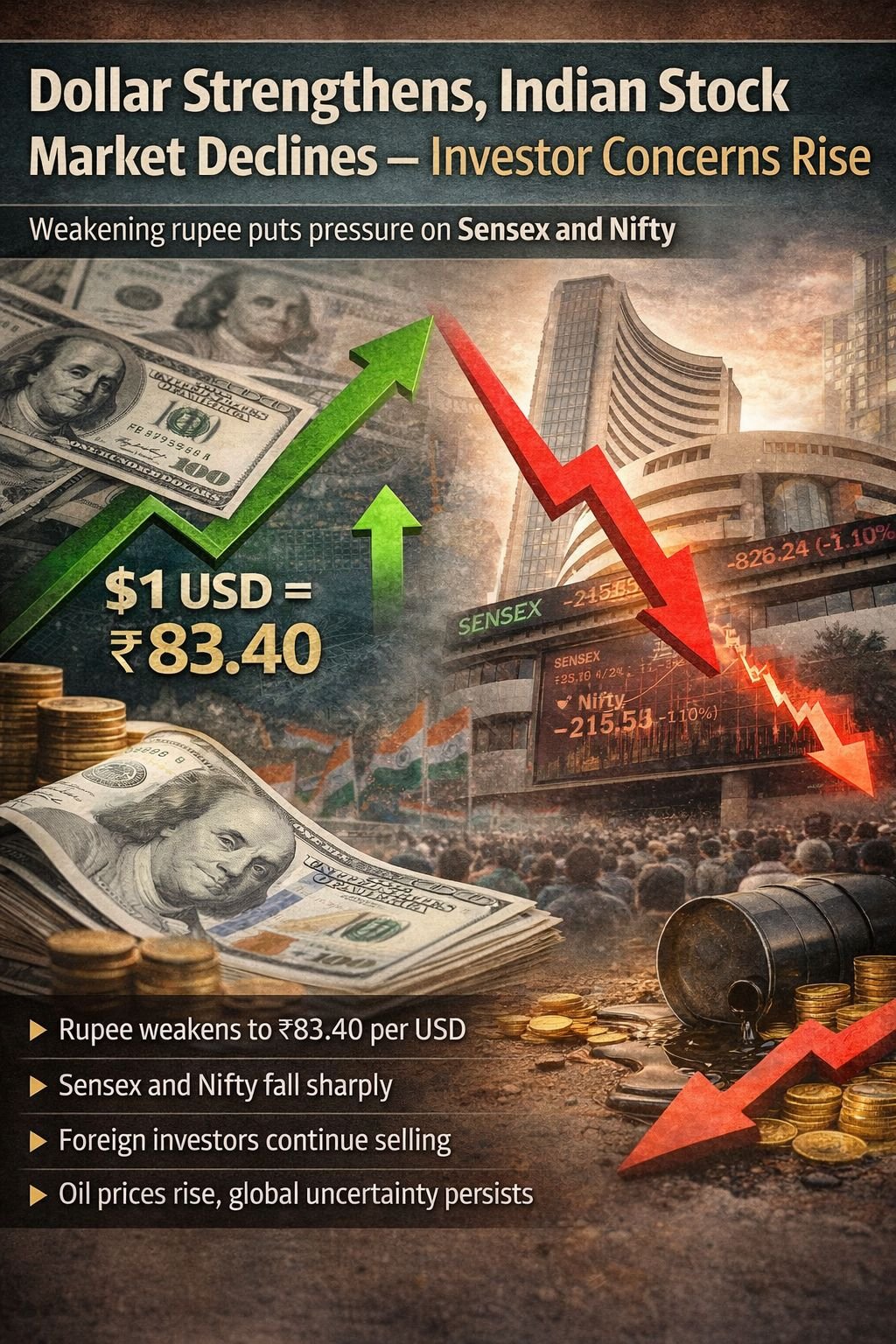
Weakening rupee against the US Dollar puts pressure on Sensex and Nifty 50
The Indian financial markets witnessed a volatile session today, as the US Dollar strengthened while the domestic stock market ended on a negative note. The combined impact has raised concerns among investors and market participants.
The Indian rupee weakened against the US Dollar, signaling pressure on the country’s external economic position. Experts believe that the strengthening of the dollar is largely driven by the resilience of the U.S. economy, expectations of higher interest rates, and a global shift of investors toward safer assets.
This development had a direct impact on the Indian stock market. Both benchmark indices, the Sensex and the Nifty 50, closed in the red. The markets remained volatile throughout the trading session, but selling pressure dominated towards the close.
Major sectors such as banking, IT, auto, and metals witnessed significant declines. Analysts noted that profit booking by investors also contributed to the downward trend, as traders chose to secure gains amid uncertain market conditions.
Foreign Institutional Investors (FIIs) played a key role in the market downturn, as continued capital outflows were observed. With the dollar strengthening, global investors are increasingly shifting funds toward the U.S. markets, which are currently seen as more stable and rewarding. This has resulted in reduced liquidity and increased pressure on Indian equities.
In addition, rising crude oil prices and ongoing geopolitical tensions have further dampened investor sentiment. For an import-dependent country like India, higher oil prices can lead to increased inflation and widen the current account deficit, adding to macroeconomic concerns.
Although Domestic Institutional Investors (DIIs) attempted to provide some support to the market, their efforts were not sufficient to counterbalance the heavy selling by foreign investors.
Market experts suggest that the direction of the Indian stock market in the coming days will largely depend on global cues, particularly the policy stance of the U.S. Federal Reserve and movements in the dollar. If the dollar continues to strengthen and global uncertainties persist, further volatility in the Indian markets cannot be ruled out.
Investors are being advised to remain cautious and adopt a balanced approach. While long-term investors may find opportunities during market corrections, short-term traders are urged to be mindful of ongoing volatility.
⸻
📊 Key Factors Behind the Movement:
• Strengthening of the US Dollar
• Weakening of the Indian rupee
• Continued selling by Foreign Institutional Investors (FIIs)
• Rise in crude oil prices
• Global economic uncertainty
⸻
📉 Possible Impact:
• Continued volatility in the stock market
• Rising inflation due to expensive imports
• Additional pressure on the rupee
• Cautious sentiment among investors
⸻