JNM journalist Hardeep Jamwal | Jammu
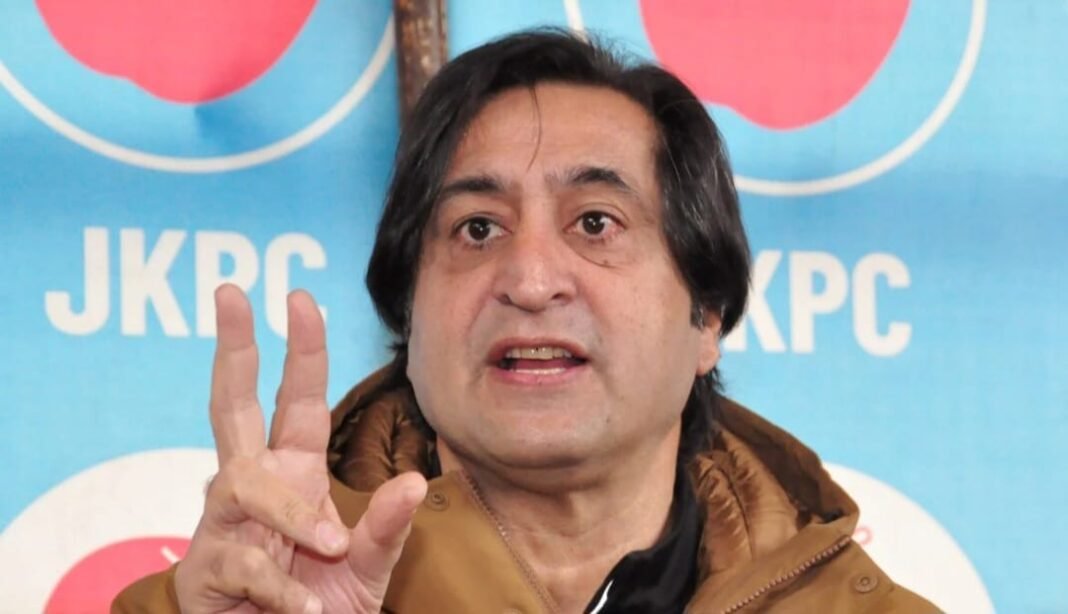
The political temperature in Jammu and Kashmir has risen sharply. During the budget debate in the Assembly, People’s Conference president and MLA Sajjad Gani Lone launched a scathing attack on the government, calling the outsourcing of 24,000 government positions a “social and economic disaster.”
Lone directly questioned the government, asking why it wasn’t being abolished now that the government has come to power, when it was opposed during the Lieutenant Governor’s rule. He alleged that the entire system is being run under pressure from the bureaucracy and at the behest of bureaucrats.
Why isn’t the government reversing the outsourcing system?
Sajjad Gani Lone said that the government’s official response clearly states that 24,000 government jobs have been outsourced in Jammu and Kashmir. This not only threatens the future of the youth but will also prove detrimental to social balance.
He said, “This system will weaken society. By providing temporary and insecure employment instead of permanent jobs, the government itself is pushing the future of its youth into darkness.”
Need for Decentralization, Disadvantages of Centralization
Lone also questioned the current administrative structure, saying that Jammu and Kashmir must move away from excessive centralization and toward decentralization. He said that in the current system, decisions are being made in files and offices rather than by the public.
This Budget is a Bureaucratic Budget
Commenting on the budget, the People’s Conference chief said that this budget is not prepared by an elected government, but entirely by the bureaucracy.
He said that when an elected government comes to power, its political and social vision is reflected in the budget, but the current budget shows no such influence.
The government was also cornered on the gas cylinder scheme.
Sajad Gani Lone also criticized the government for its election promise to provide 12 LPG cylinders to the economically weaker sections. He alleged that the government’s current announcement neither matches the election manifesto nor the ground reality.
Lone said that the government has excluded 1.4 million BPL families, now called priority families, from this scheme. Furthermore, by reducing the subsidy on diesel, the cost of gas cylinders is being indirectly recovered from the public.
Annual Expenditure of Rs. 1,680 Crore to Provide 12 Cylinders
The People’s Conference president, presenting figures, said that the government needs Rs. 1,680 crore annually to provide 12 gas cylinders to families from the weaker sections.
This cost would reach Rs. 8,500 crore over five years, while the government is currently spending only Rs. 120–130 crore annually. Even in the next three years, this amount will only increase to a maximum of 350-400 crore rupees, which is far less than the stated promises.
Government cornered on issues related to youth and the poor
Sajjad Ghani Lone’s statements regarding outsourcing, employment, the budget, and public welfare schemes appear to be increasing pressure on the government. The opposition says that if these policies are not reconsidered in time, it could have serious social and political consequences.