JNM journalist Hardeep Jamwal, Jammu
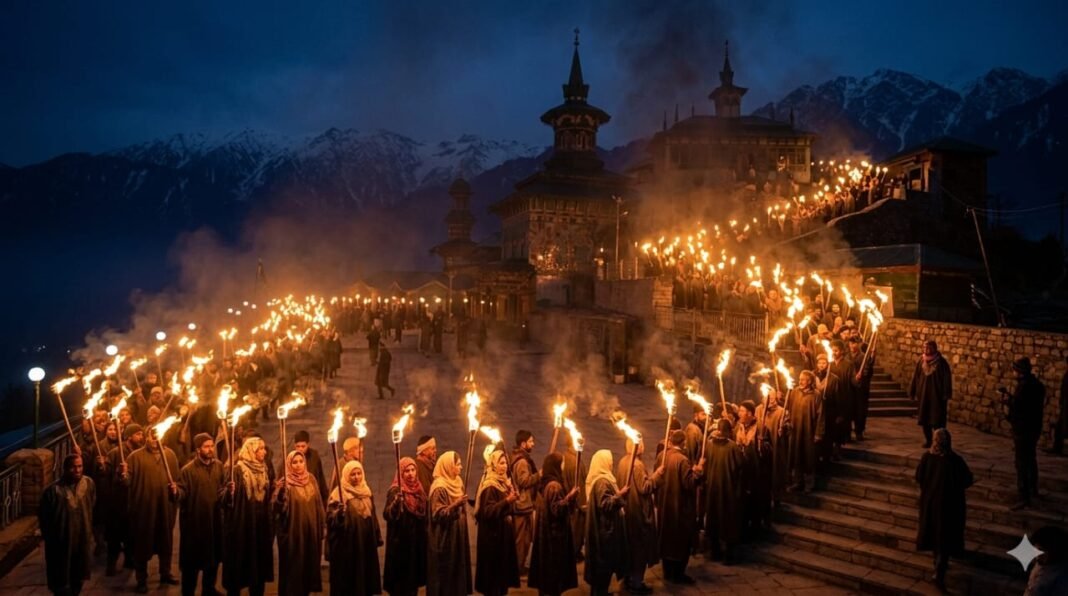
A unique and emotional festival is celebrated in the valleys of Kashmir, where burning torches become symbols not just of light but of humanity, brotherhood, and victory over fear. The three-day ‘Zul Urs’, held annually at the shrine of Sufi saint Zainuddin Wali in Ashmuqam, Anantnag district, brings this tradition to life.
‘Zul’ means lamp or torchlight in Kashmiri. This Urs is celebrated annually during the full moon of April-May and is considered a sign of the beginning of the agricultural season in Kashmir. The Urs begins on the eve of the festival, when devotees march towards the shrine with lit torches.
During this time, thousands of devotees, carrying bundles of wood and torches, arrive at the shrine of the 15th-century Sufi saint Zainuddin Wali. Here, some tie a thread to pray for their wishes, while others untie it to express their gratitude after their wishes are fulfilled.
This shrine is considered the only place in the world where devotees circle the shrine all night with lit torches to express their faith. The “Damhali” dance is also performed during the Urs, and devotees receive the blessings of the Sufi saint.
Local devotee Rafiq Ahmed said that he comes here every year from Kokernag, and for him, this Urs is a major center of faith. He says that no one returns empty-handed. Kuldeep Butt, who now lives in Jammu, says that he has not participated in this Urs only three times in his life—he has attended every other year.
According to Fayaz, who runs a shop outside the shrine, the greatest speciality of this Urs is its religious unity. People of all religions—Hindus, Muslims, and Sikhs—come together with devotion. Many prominent figures and public representatives also attend.
According to local elders, this Urs also symbolizes the change of seasons and the beginning of a new agricultural era in Kashmir. After the long and harsh winter season, when this Urs arrives, work resumes in the fields and new hopes are born.
Traditions Connected with History and Faith
Sufi saint Zainuddin Wali, considered a disciple of the great Kashmiri saint Nuruddin Noorani (Nand Rishi), was originally from Kishtwar and his real name is said to be Zia Singh. It is said that Zia Singh, who suffered from illness in his childhood, was cured by the blessings of Nuruddin Noorani, after which he adopted the spiritual path.
He lived in a cave on the hill of Ashmuqam, devoting his entire life to worship and service to humanity. Today, he is at this very spot, visited by millions of devotees every year.
Zul Urs is also alive in folklore.
According to local beliefs, this cave once harbored poisonous snakes and scorpions, which Zainuddin Wali drove away with his spiritual power. Another legend says that a demon lived here, harming people. A young man fought and killed him, and people lit torches to celebrate his victory. This tradition has continued every year since.
Today, Zul Urs is not just a religious event, but a living example of Kashmir’s Ganga-Jamuni culture, humanity, and brotherhood, where the message of victory over darkness through light is conveyed to the entire world every year.