Hardeep Jamwal, JNM Journalist, Jammu
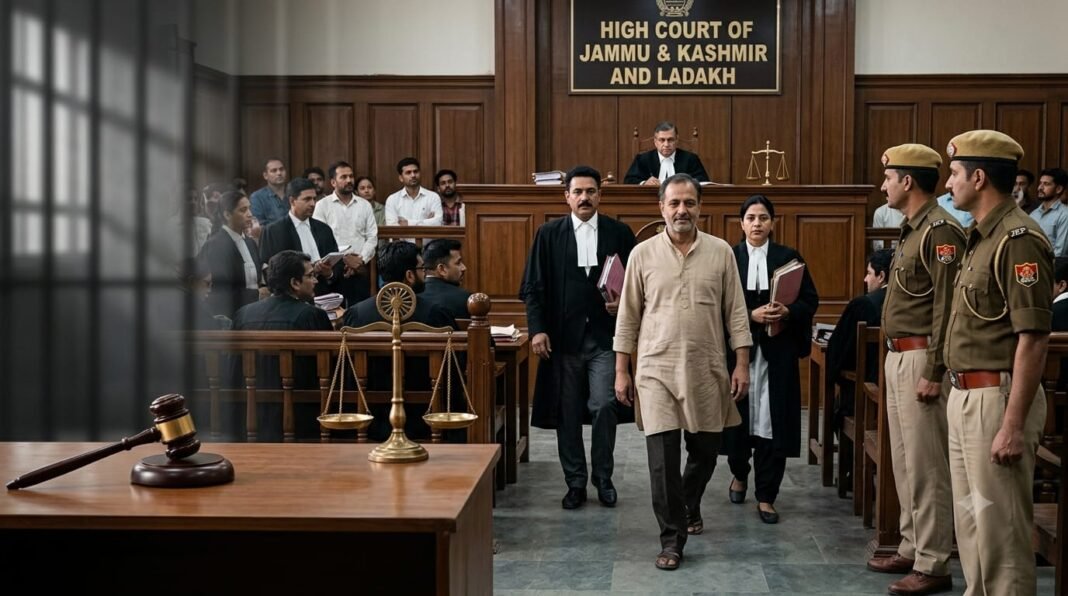
In a significant ruling regarding the high-profile 2012 Batamaloo murder case, the Srinagar Bench of the High Court of Jammu & Kashmir and Ladakh has granted conditional bail to the accused, Muneer Aziz War, after he had spent nearly 14 years in custody. The court clarified that keeping an undertrial prisoner incarcerated indefinitely due to a protracted trial violates the fundamental right to a speedy trial guaranteed by the Constitution.
Justice Sanjay Dhar of the High Court passed this order while hearing the case, which was registered at the Batamaloo Police Station on charges of murder and destruction of evidence. The accused, Muneer Aziz War, had been in continuous judicial custody since June 9, 2012. The defense counsel informed the court that despite the lapse of nearly 14 years, the trial had not yet concluded, while the accused remained incarcerated.
According to the case details, the alleged involvement of Muneer Aziz War—then the Imam of Masjid Salfia, Batamaloo—came to light during the police investigation following the disappearance of Wali Mohammad Hajam in May 2012. The deceased’s body was subsequently recovered from an open plot in Firdaus Abad. Investigating agencies also claimed to have recovered the sword used in the murder; based on this, a case was registered against the accused under various sections, including murder and destruction of evidence.
During the hearing, the government opposed the bail plea, arguing that the case was of a serious nature and that sufficient evidence existed against the accused. However, upon reviewing the records, the court observed that although the charge sheet was filed in August 2012 and charges were framed in September 2012, the testimonies of only 20 out of 23 witnesses had been recorded so far. The court held that the prosecution was primarily responsible for the extraordinary delay in the trial. Citing various Supreme Court rulings in its order, the High Court stated that granting bail is justified when the trial of an undertrial prisoner remains pending for an excessively long period with no likelihood of conclusion in the near future. The Court reiterated that Article 21 of the Constitution guarantees every individual the right to speedy justice, and undue delay cannot be countenanced.
While granting conditional bail to the accused, the Court directed him to furnish a personal bond of ₹1 lakh with two local sureties, surrender his passport, refrain from leaving Jammu & Kashmir without permission, and mandatorily appear at every hearing of the case.
This High Court ruling is being viewed as a significant decision regarding delays in the judicial process and the constitutional rights of undertrial prisoners. The Court has sent a clear message that unnecessary delays in trials cannot be allowed to infringe upon the fundamental rights of an accused.