JNM journalist Hardeep Jamwal, Jammu
The meat trade in the Kashmir Valley set a new record this time during the holy month of Ramadan. The meat and chicken trade reached over ₹600 crore for the entire month, highlighting the significant scale of the valley’s food consumption and market activity.
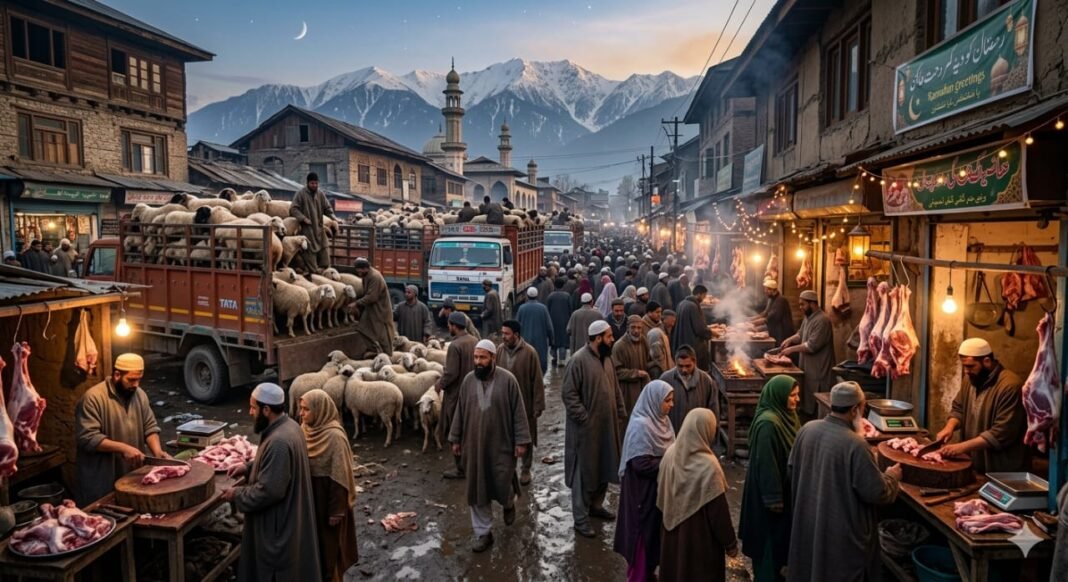
According to reports, approximately 180,000 sheep and goats and nearly 3 million chickens were imported into Kashmir from various parts of the country during Ramadan. This figure indicates that the demand for meat during this period increases manifold compared to normal times.
According to wholesale mutton dealers, while 20-25 trucks of sheep and goats arrive in the valley on a normal day, this number increases to an average of 30 trucks per day during Ramadan. Approximately 900 trucks of sheep and goats arrived in Kashmir throughout the month. A truck carries an average of 200 sheep, weighing between 25 and 65 kg.
The government has fixed the price of meat at Rs. 740 per kg, while chicken is selling for Rs. 150 per kg. The price of chopped and boneless chicken has reached Rs. 250 to Rs. 400 per kg. Despite this, there has been no decrease in demand.
A significant change was observed this time, with people preferring chicken over mutton. This is attributed to chicken’s low cost and quick cooking. Chicken was also widely consumed as a snack during Iftar.
According to the All Kashmir Butchers Association, out of a total turnover of over Rs. 600 crore, mutton accounted for around Rs. 500 crore, while chicken accounted for around Rs. 100 crore.
In addition to imports from outside states, local shepherds also contributed to meeting market demand by selling their sheep and goats in the markets.
Traders say that the demand for meat increases further during the last days of Ramadan and before Eid, further fueling the market.
Overall, Kashmir’s meat market remained economically strong during Ramadan 2026, but also reflected changing consumer preferences, especially the growing popularity of chicken.