Hardeep Jamwal, JNM Journalist, Jammu
The constantly changing weather in Jammu and Kashmir is becoming a matter of serious concern—not just for daily life, but also for the horticulture sector, which is considered the backbone of the region’s economy. Unseasonal rains, hailstorms, strong winds, and localized heavy downpours this year have caused extensive damage, particularly to Kashmir’s apple-growing regions. Experts state that this is not merely a routine weather fluctuation but a sign of the rapidly emerging climate imbalance in the Himalayan region.
Over the past few years, there has been a steady rise in extreme weather events in Jammu and Kashmir, such as cloudbursts, flash floods, severe storms, lightning strikes, and hailstorms. While such incidents were previously largely confined to mountainous areas like Doda, Kishtwar, and Ramban, their impact is now being observed in many parts of the Kashmir Valley as well.
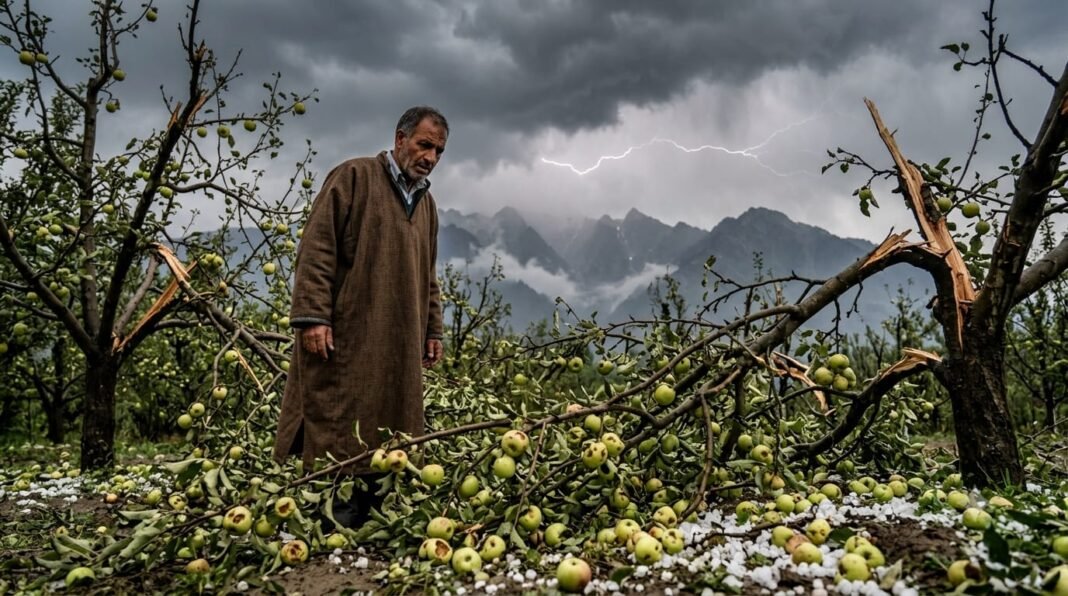
Kashmir’s apple orchards have suffered the most significant damage. In major apple-producing districts like Shopian, Pulwama, Kulgam, Anantnag, Baramulla, and Kupwara, hailstorms have severely damaged blossoms and young fruit. This has raised concerns about the potential loss of income for thousands of orchardists.
According to experts, rainfall patterns have shifted rapidly over the last decade. It is not just the volume of rainfall that has changed, but also its intensity and the frequency of sudden, heavy downpours. Rising temperatures, increased atmospheric humidity, and atmospheric instability are creating conditions that lead to a higher incidence of extreme events—such as intense short-duration rainfall, hailstorms, and cloudbursts.
Research studies have also revealed a consistent increase in extreme weather events and hailstorms in Kashmir between 2007 and 2022. Scientists believe that if this trend continues, the agriculture and horticulture sectors could face even more severe challenges in the coming years.
Local orchardists state that while weather-related damage used to be sporadic in the past, they now face some form of natural calamity almost every year. A hailstorm lasting just a few minutes can devastate an entire orchard, undoing a year’s worth of hard work by the farmers.
Meteorologists note that the weather in Jammu and Kashmir is primarily influenced by Western Disturbances and local atmospheric conditions. Although attributing any single event directly to climate change is not considered scientifically appropriate, the increasing frequency of extreme weather events serves as a clear warning of the changing climate cycle in the Himalayan region.
Experts believe that unless new strategies for agriculture and horticulture are devised in a timely manner—taking the impacts of climate change into account—the livelihoods of lakhs of farmers and orchardists in the region could face a serious crisis in the years ahead. Amidst these changing weather patterns, adopting modern technology, accessing accurate and timely weather information, and implementing crop protection measures have become more essential than ever before.