JNM Journalist Hardeep Jamwal, Jammu
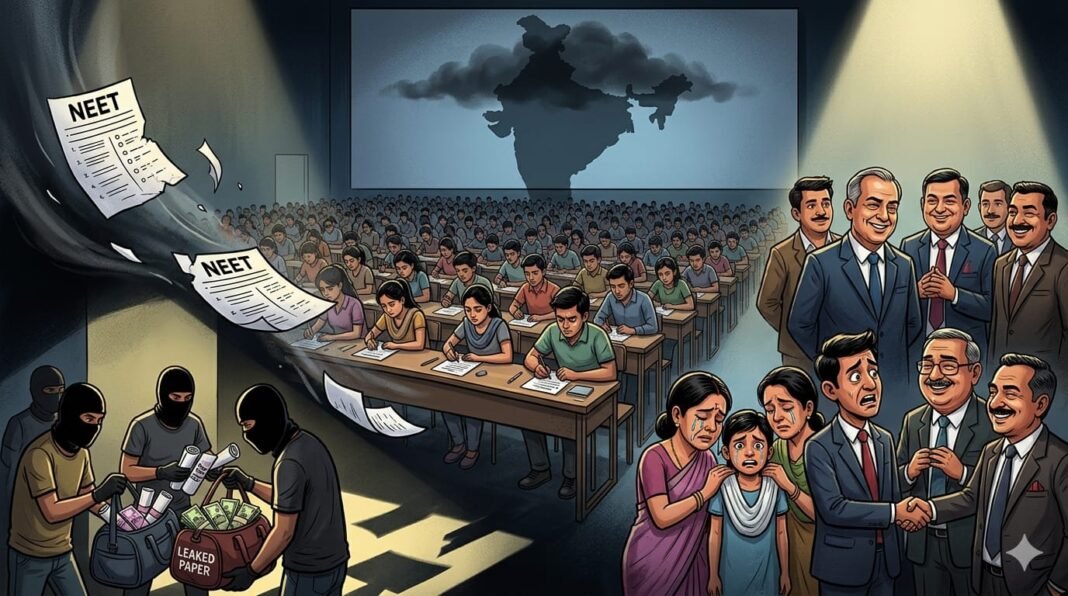
The country’s most prestigious medical entrance examination, NEET, finds itself at the center of controversy once again. Amidst allegations of a paper leak and the active involvement of investigative agencies, the most pressing question arising is this: how, exactly, does the question paper for such a massive and high-security examination manage to get leaked? Is this merely a ploy orchestrated by a few middlemen, or does it point to a deeper, hidden collusion lurking within the system itself?
Every year, lakhs of students toil day and night, driven by the dream of becoming doctors. Many families go so far as to sell their land or take out loans to enroll their children in coaching classes. However, when reports surface—even before the examination has begun—that the question paper is already being sold on the open market, the greatest shock is felt by those very students who have prepared with absolute honesty and integrity.
According to experts, a paper leak is by no means considered a routine occurrence in any national-level examination. The entire process—from the drafting of the question paper to its printing, transportation, and eventual delivery to the examination centers—is designed to be strictly confidential. Given this context, the question inevitably arises: where, precisely, is the security breach occurring?
Based on the preliminary actions taken by investigative agencies and the patterns observed in previous cases, there is a strong suspicion that a multi-layered network is operating behind these paper leaks. Questions have been raised regarding the potential involvement of various entities, ranging from printing presses, transport chains, and examination centers to technical staff, the “coaching mafia,” and local middlemen. In several instances, it has even come to light that question papers were made available for exorbitant sums of money just a few hours prior to the commencement of the examination.
Education experts believe that the burgeoning “coaching market” surrounding competitive examinations is also exerting a detrimental influence on the entire system. Success in medical and engineering entrance exams is no longer solely a matter of academic study; it has now become inextricably linked to a multi-crore business enterprise. In this environment, paper-leak syndicates exploit the desperation and vulnerability of students and their parents.
Perhaps the most alarming aspect of this recurring crisis is that while every paper leak is invariably followed by investigations, arrests, and public rhetoric, the matter eventually fades from public memory after a brief period. This, perhaps, is the very reason why these criminal networks manage to reactivate themselves time and again.
Now, another critical question looms large: if the suspicions regarding the paper leak prove to be true, should the examination be cancelled? On one hand, there are millions of honest students who have worked hard; on the other, there are those who have allegedly influenced the system by paying bribes. Under these circumstances, how can fairness be ensured?
Many students and parents argue that if the exam paper was indeed leaked, a re-examination should be conducted to ensure equal opportunities for everyone. Conversely, some experts believe that repeated exam cancellations exacerbate mental stress and uncertainty, ultimately impacting the students’ future.
Another major question arising from this entire episode concerns political and administrative accountability. After all, given the extensive claims regarding security surrounding the country’s most sensitive examinations, why do reports of irregularities continue to surface every so often? Is technical surveillance inadequate? Is a paper leak on such a massive scale even possible without internal collusion?
What is needed today is not merely the arrest of the culprits, but a comprehensive overhaul of the entire examination machinery. Until every process—from the setting of question papers to their administration at exam centers—becomes fully transparent and accountable, it will be difficult to restore the students’ trust.
For this issue is not merely about a single examination; it is about the dreams of millions of young people who aspire to build their future through the sheer strength of their hard work.