JNM Journalist Hardeep Jamwal, Jammu
On Wednesday evening, a scene unfolded at Jammu’s historic Raghunath Temple that not only gave a new direction to centuries-old traditions but also set a new precedent for women’s empowerment.
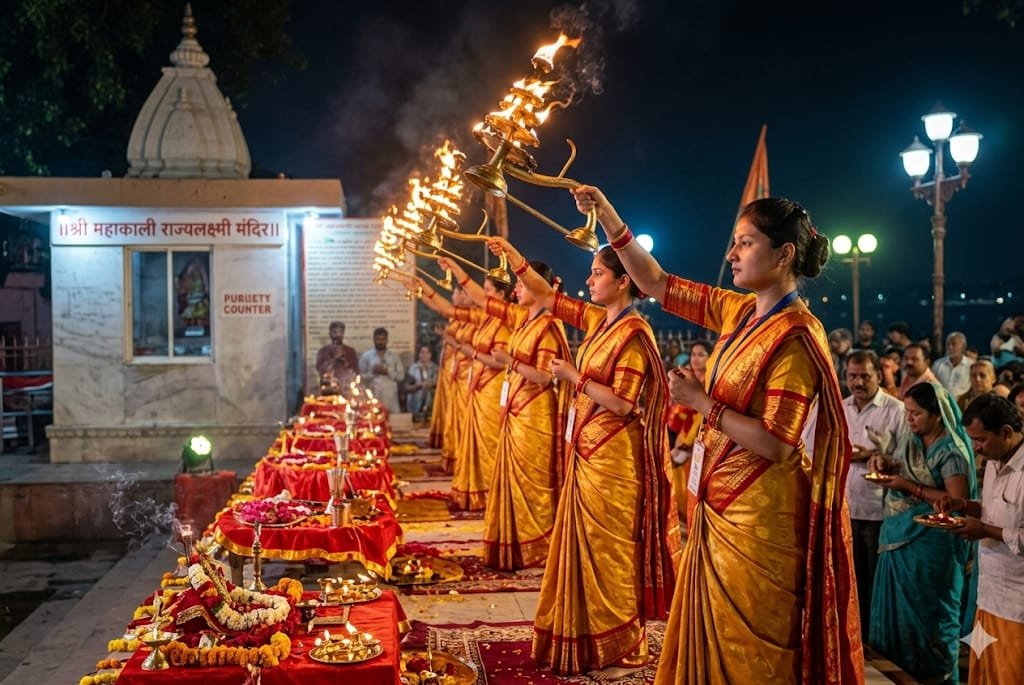
Adorned in saffron sarees, young women held lit lamps in their hands, with Vedic mantras resonating on their lips and confidence shining in their eyes. As these women collectively led the Sandhya Aarti (evening prayer) within the temple’s sanctum sanctorum, the devotees present were moved to tears. This marked the first occasion on which women—who are currently undergoing training to become priestesses—led the Aarti at the Raghunath Temple.
Established in 1835, the Raghunath Temple has witnessed the era of kings, seen the flame of devotion burn bright even during times of war, and served as a focal point of faith for millions of devotees. But this time, the temple appeared to be writing a new chapter in its history.
Kunwarani Ritu Singh—granddaughter-in-law of Maharaja Hari Singh—played a pivotal role in bringing about this transformation. Despite the hesitation and resistance prevalent in society, she took the initiative to secure equal rights for women in religious rituals.
Kunwarani Ritu Singh stated that her objective is not to diminish the role of men, but rather to reinforce the concept of Shiva and Shakti—a philosophy in which both the male and the female are equal. Posing a pertinent question, she asked: “When we perform Kanya Pujan (worship of young girls) and Devi Pujan (worship of the Goddess), why should women be barred from conducting the worship?”
Under this initiative, which began approximately one year ago, women are being trained in Vedic mantras and religious rituals. Currently, around 150 young women have joined this program, and the number is expected to rise further in the near future.
According to Ritu Singh, the next phase will involve training these women in Havan (sacred fire rituals) and other religious ceremonies, enabling them to offer their services as priestesses in various temples. She believes that this step will prove instrumental in making women self-reliant and empowered.
Devotees visiting the temple also welcomed this change with open hearts. Devotee Mini Bagotra remarked that she never imagined she would witness women leading the aarti in a temple during her lifetime. Meanwhile, Rajni Sehgal stated that this is not merely a matter of holding the aarti platter, but rather a moment to determine who holds the right to carry forward the legacy of faith—and today, Jammu has provided a positive answer to this question.
The aarti performed by women at the Raghunath Temple was not merely a religious ritual; it was a reflection of a changing society—one in which traditions are embracing new ideas over time while simultaneously preserving their core spirit.