Hardeep Jamwal, JNM Journalist (Jammu)
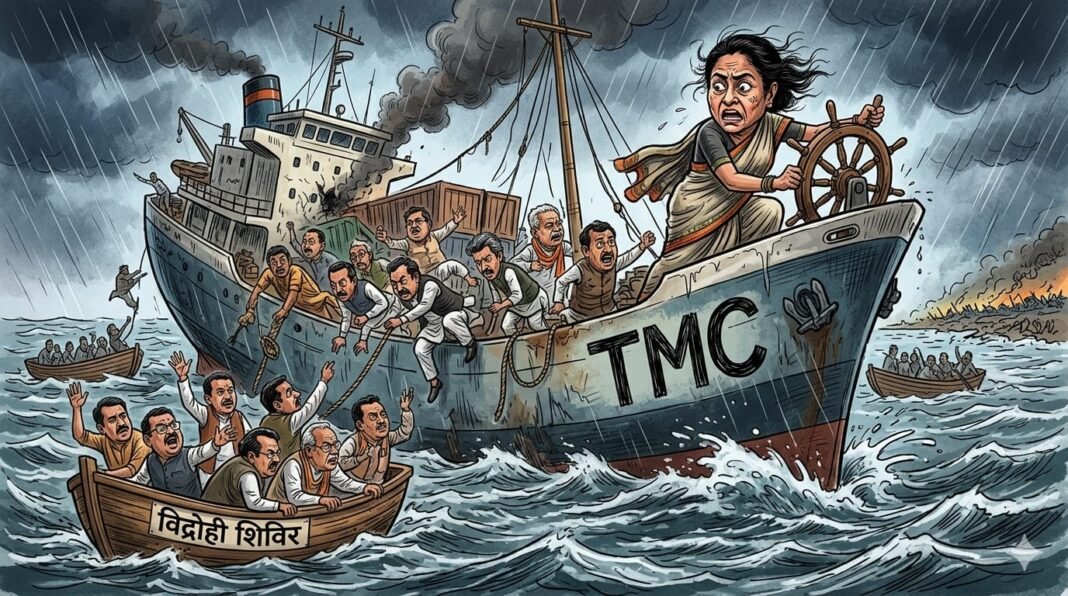
The Trinamool Congress (TMC) appears to be grappling with its biggest political crisis in West Bengal. The sparks of discontent that emerged following the assembly election defeat now seem to be transforming into an open rebellion. The situation has become so critical that even a senior party leader and former Mayor of Kolkata, Firhad Hakim, has been seen in contact with the rebel faction, stirring up a buzz in political circles.
Political temperatures soared at the assembly complex on Monday when rebel MLA Sandipan Saha arrived directly at the chamber of the Leader of the Opposition, Ritabrata Banerjee, accompanied by Firhad Hakim. This meeting is being viewed as a significant development in the ongoing fragmentation within the TMC. Political analysts believe this is not merely a formal meeting but a public signal of the growing unrest within the party.
The party leadership’s grip appears to be weakening following the electoral defeat. Reports indicate that 58 out of the 80 TMC MLAs in the assembly have openly revolted against the official leadership. Refusing to accept the Leader of the Opposition chosen by the party leadership, these MLAs have declared Ritabrata Banerjee as their leader.
The flames of rebellion now appear to be spreading beyond state borders into national politics. Senior Rajya Sabha MP Sukhendu Sekhar Roy has resigned from both the party and Parliament. Following this, rebel leaders have claimed that several other MPs might also leave the TMC in the coming days. According to sources, some disgruntled party MPs have held meetings with BJP leaders, fueling intense political speculation.
Meanwhile, rebel leader Ritabrata Banerjee has leveled serious allegations against the party leadership. He stated that senior leaders within the party are being sidelined and that the decision-making process has become restricted to a select few. He further alleged that, within the organization, preference is being given to loyalists over those with experience.
According to political analysts, Firhad Hakim’s association with the dissident faction could prove to be a major setback for the TMC. Hakim has long been considered a key figure representing the party’s Muslim vote bank and urban politics; consequently, his move closer to disgruntled leaders has become a cause for concern for the party leadership.
Although the TMC leadership has not yet issued a detailed response regarding these developments, the rapid rise of internal dissent has sparked discussions about shifting political equations in West Bengal. In the coming days, it will be crucial to observe whether Mamata Banerjee can steer the party out of this political crisis or if the rebellion evolves into an even greater challenge for the TMC.