JNM | Journalist Hardeep Jamwal | Jammu
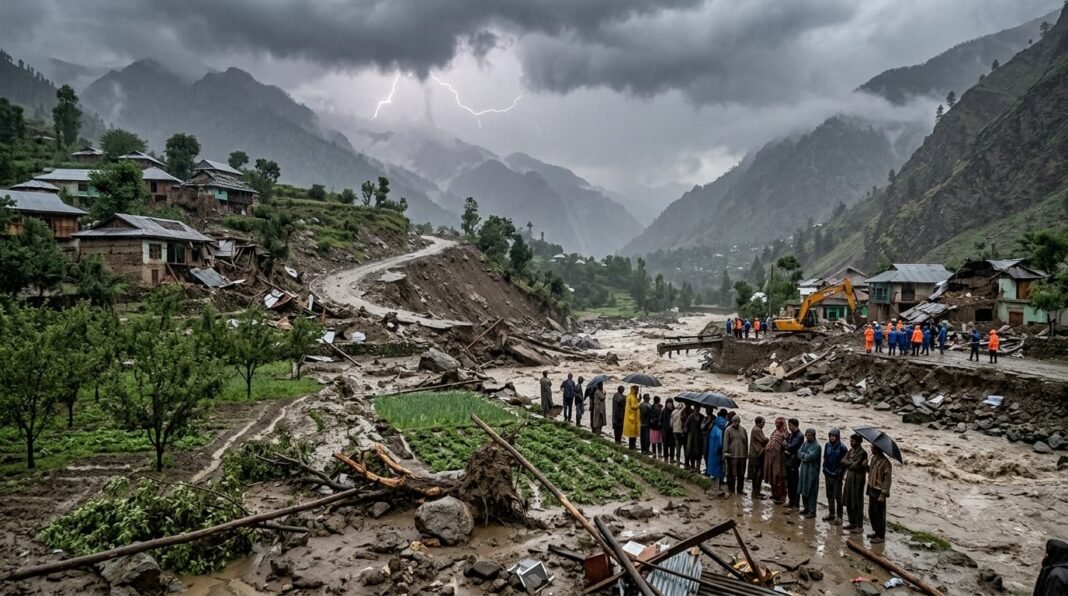
Continuous heavy rainfall and cloudbursts at two locations in the Doda district of Jammu and Kashmir have wreaked widespread havoc. Flash floods, triggered by two successive cloudbursts in the Khaljugasar area of the district’s Bhallesa region, have caused extensive damage to agricultural fields, orchards, houses, and road connectivity. Several villages have been completely cut off due to the natural disaster, while the administration has intensified relief and rescue operations.
According to reports, the flash floods—accompanied by strong currents following the cloudbursts in the Khaljugasar area—have undone the farmers’ hard work. Hundreds of kanals of agricultural land were engulfed by debris, while standing crops and fruit orchards were completely destroyed. Numerous houses and private properties also sustained damage. Affected families have demanded immediate relief and compensation from the government.
Heavy rains have also led to the closure of several major roads in the Doda district. Notably, the Bhatyas area of Bhallesa remained completely cut off from other regions for hours. Meanwhile, torrential rains created flash-flood-like conditions in the Kashtigarh area as well. However, there is some relief in the fact that no loss of life has been reported so far.
The flash floods brought down massive amounts of debris, boulders, and trees onto the roads, completely blocking several routes. With road connectivity to many villages severed, there are growing concerns regarding the supply of essential commodities. Local residents are also facing difficulties in procuring daily necessities.
The administration has stated that road restoration work will be accelerated only after the weather improves and the area is declared safe. Roads have caved in at several locations due to landslides, which may prolong the repair process. Due to cloudbursts and incessant rainfall, several streams and water sources in the region are overflowing. Waterlogging and soil erosion in low-lying areas have further compounded the difficulties faced by the residents. The administration has deployed machinery to clear debris and reopen roads in the affected areas.
Given the gravity of the situation, the district administration has mobilized disaster management teams. These teams are continuously visiting the affected areas and remain fully prepared to handle any emergency. While the ongoing rain poses a challenge to relief and rescue operations, the administration is exploring alternative routes to reach stranded individuals.
The administration has urged locals to avoid unnecessary travel until road connectivity is fully restored. People have been advised to stay away from landslide-prone areas, remain in safe locations, and rely solely on official information issued by the administration. They have also been asked to contact helpline numbers in case of an emergency and to disregard rumors.
This natural disaster in Doda has once again highlighted the vulnerability of hilly regions. The affected families are now looking towards relief, rehabilitation, and adequate compensation for crop losses.