JNM Journalist Hardeep Jamwal, Jammu
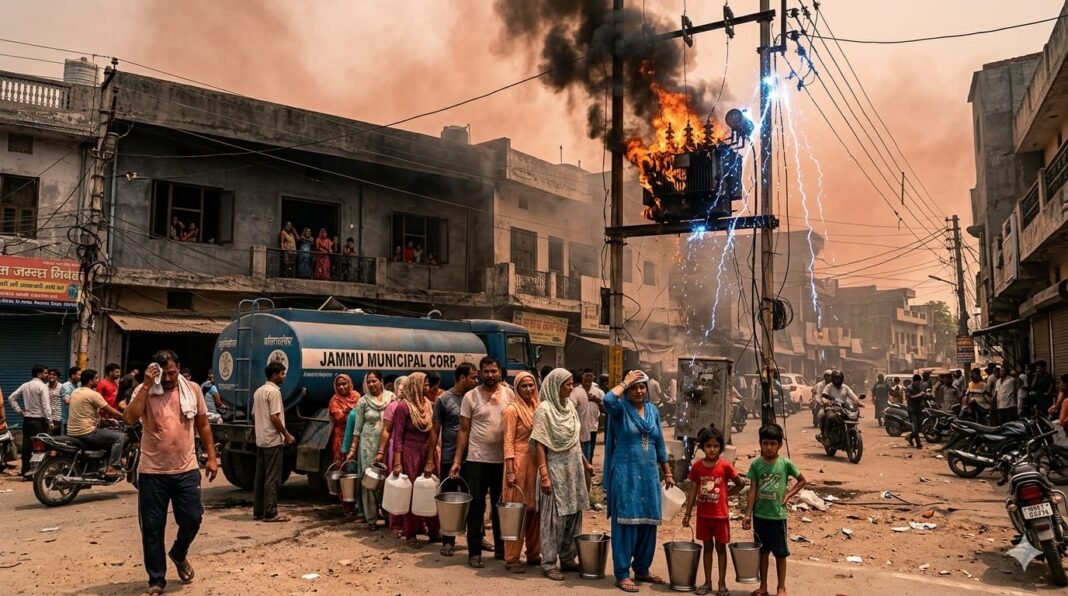
The Jammu division is currently facing a double whammy. On one hand, the sky is raining fire; on the other, the power infrastructure has completely crumbled. The scorching heat, coupled with an electricity load that has surged to record levels, has broken the back of the power system. The situation has deteriorated to such an extent that more than 40 transformers are burning out daily across the Jammu division, leaving thousands of families compelled to endure hours of darkness and acute water shortages.
Temperatures are rising continuously, prompting people to increase their reliance on ACs, coolers, and fans in search of relief. Due to this mounting pressure, the electricity load has soared past the 1650 MW mark. However, the aging and fragile power infrastructure is unable to bear this burden. Consequently, transformers are burning out rapidly across the region—from the cities right down to the villages.
On Wednesday, the situation in several parts of the Jammu division remained extremely alarming. In the Bishnah, Akhnoor, R.S. Pura, and Arnia sectors, over 20 transformers burnt out, while numerous transformers also malfunctioned in areas such as Gangyal, Narwal, Bathindi, Majeen, Talab Tillo, and Roopnagar. Mid-day power outages made life miserable for the residents. Fans in homes ground to a halt, ACs and coolers ceased functioning, and people were seen drenched in sweat amidst the sweltering heat.
The electricity crisis has further exacerbated the water scarcity issue. Water supply remained disrupted in several localities, including Janipur, Bantalab, Muthi, Rehari, Lakhdata Bazaar, Sidhra, and Qasim Nagar. Residents repeatedly called for government water tankers, but adequate assistance could not be provided. Left with no alternative, many families were forced to hire private tankers to meet their daily water requirements. According to sources, the electricity corporation had approximately 600 transformers in reserve; however, more than 350 of them have already been utilized. If this situation persists, there is a risk that the reserve stock will be completely depleted in the coming days. Repair work on transformers is proceeding around the clock at the department’s workshops, yet the escalating heat and system overloads are continuously inflicting damage upon the infrastructure.
The situation has become so critical that the electricity department is now appealing to the public to use electricity judiciously—only as per their actual requirements. Officials state that running multiple air conditioners in a single household is placing immense strain on the power grid. If people do not exercise restraint, the crisis could deepen further in the days ahead.
Locals point out that this same scenario unfolds every summer, yet no significant steps appear to be taken toward finding a permanent solution. The public is raising pertinent questions: given that temperatures rise every year, could the department not have made adequate preparations in advance? How long, after all, are people expected to endure a life plagued by power cuts, water shortages, and burning transformers?
At present, Jammu is reeling not only from the scorching heat but also from a dilapidated power infrastructure. If concrete measures are not implemented swiftly, the situation could become even more dire in the days to come.