JNM Journalist Hardeep Jamwal, Jammu
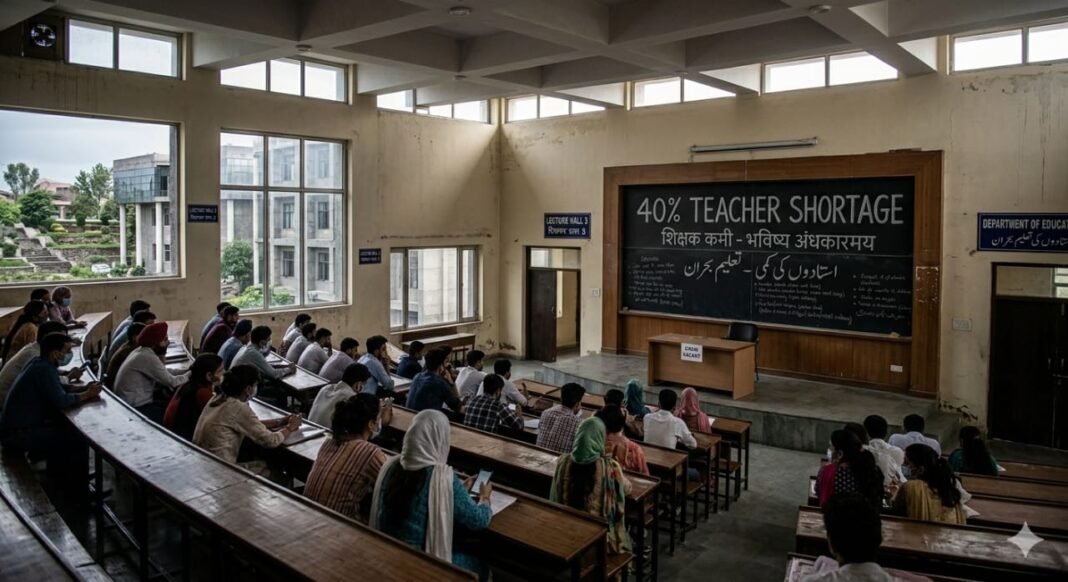
The higher education system in Jammu and Kashmir is currently facing a serious crisis. There is a severe shortage of teaching staff in the state’s universities, with nearly 40 percent of positions vacant. The situation is such that many universities are forced to operate with only half their staff, raising serious questions about the quality of education.
According to data from the Higher Education Department, a total of over 3,300 teaching positions are sanctioned in the state’s nine state universities and two central universities, but only about 1,900 have been filled. This data clearly indicates that a large number of positions have been vacant for a long time and the recruitment process is being delayed.
Speaking of major universities, Jammu University has only 252 teaching positions against 442, meaning approximately 43 percent of the positions are vacant. Meanwhile, the University of Kashmir has 373 teachers out of 570, resulting in a shortage of approximately 35 percent.
The Sher-e-Kashmir University of Agriculture, Science and Technology, Jammu, has 237 teachers against 411 positions, while the same university in Kashmir has 424 available teachers out of 540. Despite this, there is a shortage of teachers here as well.
The situation is even more worrisome in some universities. Baba Ghulam Shah Badshah University, Rajouri, has only 93 teachers against 241 positions, leaving over 60 percent vacant. Similarly, at the Islamic University of Science and Technology, Awantipora, nearly two-thirds of the positions are vacant.
The situation is relatively better in central universities, but shortages persist there as well. The Central University of Jammu has 160 teachers against 177, while the Central University of Kashmir has only 108 teachers out of 195 available.
Over 69,000 students are enrolled in the state’s universities, most of whom are local. Approximately 3,465 non-local students, including 12 foreign students, are also pursuing their education. Consequently, the shortage of faculty is directly impacting students’ studies, research, and academic development.
Education experts believe that if these vacant positions are not filled soon, the state’s higher education system could suffer long-term losses. Lack of adequate guidance for students could also impact their futures.
The key question now is how much priority the government will give to this serious issue and when concrete steps will be taken to fill these vacant positions in universities.