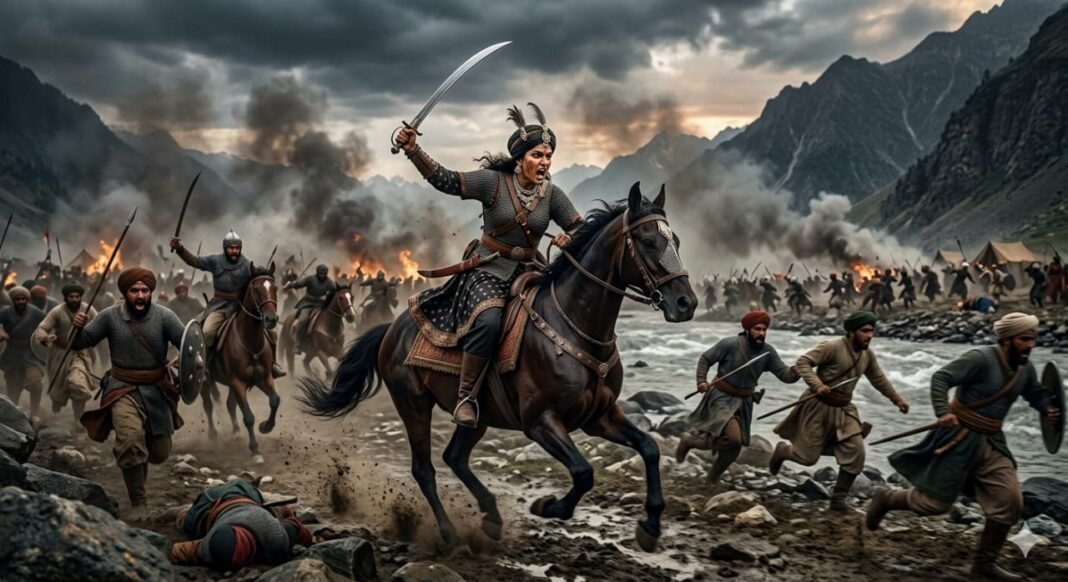
The land of Kishtwar has, for centuries, borne witness to valor, sacrifice, and a deep love for the motherland. Even today, within its hills and valleys, numerous legends survive—tales that have left an indelible mark upon the pages of history. Among these heroic sagas, one name is spoken with immense respect and pride: Kokila Devi. In the year 1604, through her extraordinary courage and martial prowess, she defeated the Mughal army and successfully defended Kishtwar.
At that time, Kishtwar was under the rule of King Raya Singh. The Mughal Empire, in its quest for expansion, sought to annex the hilly regions; with this objective in mind, the Mughal army marched toward Kishtwar. While the Mughal forces were vastly superior in terms of numbers and resources, the people of Kishtwar possessed an indomitable spirit—an unwavering resolve to defend their motherland.
Amidst this looming crisis, Kokila Devi—a resident of Kulira village (known today as Kulid)—could not remain a silent spectator to the peril threatening her people. She harbored a profound love for her motherland and possessed the unshakeable courage to confront the enemy. She personally sought King Raya Singh’s permission to join the battle. Initially, the King was taken aback, for in that era, it was highly uncommon for women to step onto the battlefield. However, Kokila Devi’s self-confidence and unwavering determination deeply impressed the King, and he granted her permission to participate in the war.
Kokila Devi donned the attire of a warrior and stepped onto the battlefield. Concealing herself in an ambush along the banks of the Chenab River, she launched a sudden, surprise attack on the Mughal soldiers. She wielded her sword with such speed and valor that the Mughal soldiers were caught completely off guard. Struck by her blows, many soldiers fell wounded into the river. The enemy army was utterly bewildered, unable to comprehend who was attacking them; it began to feel as though some invisible force had descended upon them.
Gradually, fear and chaos spread throughout the ranks of the Mughal army. The soldiers began to retreat and flee in disarray. Seizing this very opportunity, the army of Kishtwar—led by Kokila Devi and Narayan Parihar—pursued the Mughals. Ultimately, a decisive battle took place between the two armies at the site known today as “Mughal Maidan.” The Kishtwar forces encircled the Mughal soldiers from all sides, inflicting upon them a crushing defeat. A large number of Mughal soldiers were killed, while the survivors fled in terror.
It is said that, following the battle, the site came to be known as “Mughal Mazar”—a name that, over time, evolved into the renowned “Mughal Maidan.” Kokila Devi’s role in this historic victory is considered to be of paramount importance. She not only defended her motherland but also demonstrated that courage, patriotism, and sacrifice are not confined to any single class or group.
By laying down her life in its defense, Kokila Devi protected Kishtwar and attained immortality in the annals of history. Her story remains a source of inspiration for women and the youth to this day. Her life conveys the message that when the motherland faces peril, courage and self-sacrifice emerge as the greatest strengths.
Even today, the echoes of Kokila Devi’s valor resonate across the land of Kishtwar, and people recall her immortal saga with immense pride.
— Kritika Thakur
B.A.-LL.B. Student, University of Jammu